


TOPICS & CATEGORIES
By Cassidy Mills, Staff Writer
April 14, 2026
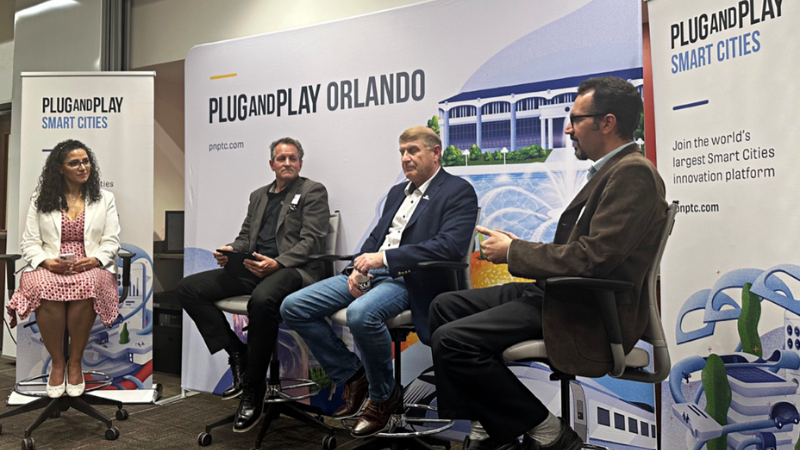
Industry and academia discussed how digital twins are transforming urban planning, infrastructure design and city resilience through real-time simulation and predictive intelligence during a panel session hosted by Plug and Play Tech Center at the University of Central Florida (UCF) on April 2.
Plug and Play’s mission is to build the world’s leading innovation platform and make innovation open to anyone, anywhere, by connecting entrepreneurs, corporations and investors worldwide.
Moderated by Rosangela Parker, senior program manager at Plug and Play, panelists included Yaser Fallah, Ph.D., co-founder and president of Currus AI and professor in the Department of Electrical and Computer Engineering at UCF; Neal Finkelstein, Ph.D., chief operating officer of the National Center for Simulation (NCS); and David Metcalf, Ph.D., director of the Mixed Emerging Technology Integration Lab (METIL) at UCF’s Institute for Simulation and Training (IST).
The session opened with panelists noting that while digital twins are not a new concept, the pace and scale of their evolution are rapidly accelerating. Fallah said what began as simple modeling has grown into systems that integrate real-time data with simulation.
“It’s the integration of the physical and digital world,” Fallah said. “At the end of the day, it’s a digital representation of something physical that allows you to understand it better and use it to improve operations and reduce costs.”
Throughout the discussion, the panel pointed to practical applications already underway in Central Florida and beyond. From autonomous vehicle testing in Lake Nona to infrastructure planning and healthcare facility design, Finkelstein said digital twins are helping organizations simulate outcomes before making costly real-world decisions.
“You can try things out before you actually build them,” Finkelstein said. “It allows you to test different scenarios in a model and understand what works and what doesn’t before making costly decisions in the real world.”
Cost savings and efficiency gains were recurring themes. By enabling cities to test scenarios in a virtual environment, Finkelstein said digital twins reduce the risks associated with large-scale infrastructure investments. He highlighted that
“It allows you to figure out what works and what doesn’t almost instantly,” Finkelstein said. “Simulation drastically shortens deployment timelines by identifying issues before systems go live.”
However, adoption is not without challenges. Metcalf pointed to organizational resistance, lack of standardization and the rapid pace of technological change as key barriers. He said many municipalities struggle to integrate new tools into existing systems, particularly when dealing with legacy infrastructure and siloed agencies.
“There’s not really a defined process for adopting these technologies,” Metcalf said. “A lot of it depends on whether someone inside recognizes the opportunity and pushes it forward within the organization.”
Data management also remains a critical hurdle. Collecting, storing and securing the large volumes of data required for accurate digital twins requires strong infrastructure and coordination.
“It’s all about the data — how you collect it, store it and use it,” Metcalf said. “You have to be able to bring that data together in a meaningful way, because that’s what ultimately drives the value and effectiveness of the digital twin.”
Despite these challenges, the panelists expressed optimism about the near future. Advances in AI, visualization and computing power are expected to make digital twins more accessible and more integrated across systems.
“In a few years, these tools will be much more connected,” Fallah said. “You’ll be able to bring different systems together and use them in ways we can’t fully do today.”
In the next few years, cities could leverage digital twins for real-time disaster response, infrastructure optimization and predictive maintenance at a much larger scale. Technologies such as advanced visualization, AI-driven modeling and immersive interfaces are already being tested.
“You can run many different scenarios and see the outcomes before making decisions,” Fallah said. “That’s where this is going, giving organizations the ability to explore options and make more informed choices ahead of time.”
People who read this article also found these articles interesting :


INDUSTRY NEWS


