


TOPICS & CATEGORIES
By Cassidy Mills, Senior Staff Writer
October 13, 2026
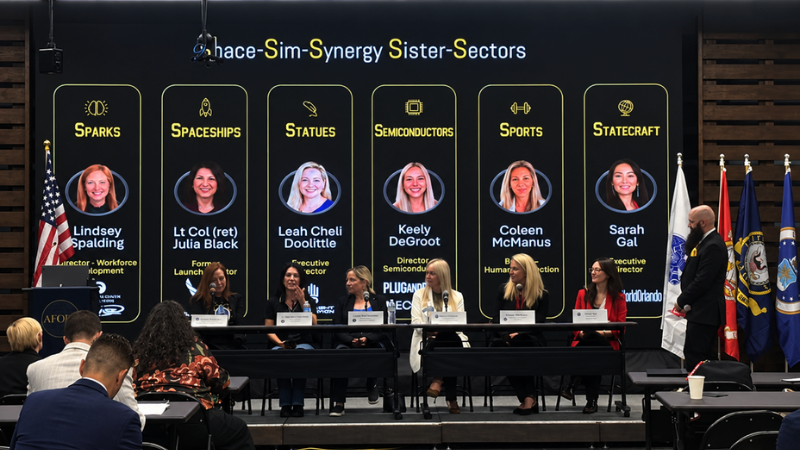
An all-women panel of leaders from the space, technology, workforce development and business communities examined opportunities for cross-sector collaboration to help build Central Florida’s space ecosystem during the “Space-Sim Sisters: Synergizing Sector Smash-Ups” panel at TechNet Orlando 2026 on Sept. 17.
Hosted by the Armed Forces Communications & Electronics Association International (AFCEA) Orlando Chapter at Central Florida Tech Grove, the inaugural TechNet Orlando event served as a forum for discussions about defense technology, innovation, experimentation, workforce development and emerging capabilities.
Moderated by Robert S. Katz, chief executive officer and executive director of the World Innovation Network (WIN), the panel included Lindsey Spalding, director of workforce development for the National Center for Simulation (NCS) and director of DoD STARBASE Central Florida; Lt. Col. (ret.) Julia Black, former launch director for the U.S. Air Force; Leah Cheli Doolittle, executive director of EarthLight Foundation; Keely DeGroot, director of semiconductors at Plug and Play Tech Center; Coleen McManus, builder of human connection at Spartan; and Sarah Gal, executive director of WorldOrlando.
Katz opened the discussion by emphasizing the interconnected nature of Central Florida’s space ecosystem, pointing to industries including software, semiconductors, sensors, supply chain, spectrum and cybersecurity.
He described the relationship as a “complete flywheel,” with those sectors supporting space while space also supports their development.
“It takes all of us working together to be able to secure space and therefore secure all of the other sectors that we work with,” Katz said. “Not only do those sectors support space, but space also supports all of those sectors.”
Spalding discussed the role of education and workforce development in preparing the next generation for careers connected to simulation and space.
“We have been promoting, protecting and growing the modeling and simulation workforce for the past 33 years, from DoD programs to programs for 10-year-olds,” Spalding said. “I have teachers who come through those programs who are giving students the introduction, practice, tools and skills to allow them to simulate their future in the classroom.”
Black focused on the growing complexity of space operations and the need to integrate space activities with other transportation and operational systems.
“That’s the goal: repeatable flight, integrating into the national airspace system and deconflicting with our aviation partners,” Black said. “It’s more than just the astronaut, and it’s more than just the rocket — it is this whole ecosystem that everyone’s involved with.”
Doolittle discussed the importance of expanding public understanding of the space sector and creating opportunities for people from different professional backgrounds to participate.
“We really do view space as just an extension of the human homeworld,” Doolittle said. “We want people to make that connection and understand that they have a place in space.”
She added that her work at EarthLight Foundation includes space advocacy, policy and efforts to create a broader space culture. Doolittle discussed her work in space law and the need to consider how existing laws may need to adapt as activities expand beyond Earth.
“A lot of people think that there are barriers to entry into the space industry,” Doolittle said. “They think they’re not an aerospace engineer or they’re not military, so they’re not really sure how to get involved.”
DeGroot highlighted the role of startups, industry partnerships and investment in moving new technologies toward the space sector.
“We work with startups across the world and industry partners to make sure that they get their innovation into space, into whatever environment they’re working in,” DeGroot said. “Behind the scenes, we also invest in our startups to make sure that they have the funding to bring their products to life.”
McManus focused on human performance and resilience, drawing a connection between physical challenges and the preparation needed for demanding missions.
“My passion is building and creating really cool humans, so we can develop and train people in resilience to help them really perform beyond their perceived limits,” McManus said. “We can all get in our heads about what our limits would be, but you just don’t know.”
Gal discussed WorldOrlando’s role in connecting international space professionals with counterparts in Central Florida.
“We connect international space professionals with their Central Florida counterparts, so that could be CEOs, engineers, policymakers, researchers and others,” Gal said. “This year alone, we’re bringing space professionals from more than 25 countries to Central Florida, and these exchange projects help keep Florida essential to the space supply chain by connecting the people who actually build, launch and sustain these systems.”
The panel highlighted the range of sectors involved in Central Florida’s space community and the different roles those sectors play in developing the workforce, technologies, relationships and capabilities needed to support space activity.
People who read this article also found these articles interesting :


INDUSTRY NEWS


