


TOPICS & CATEGORIES
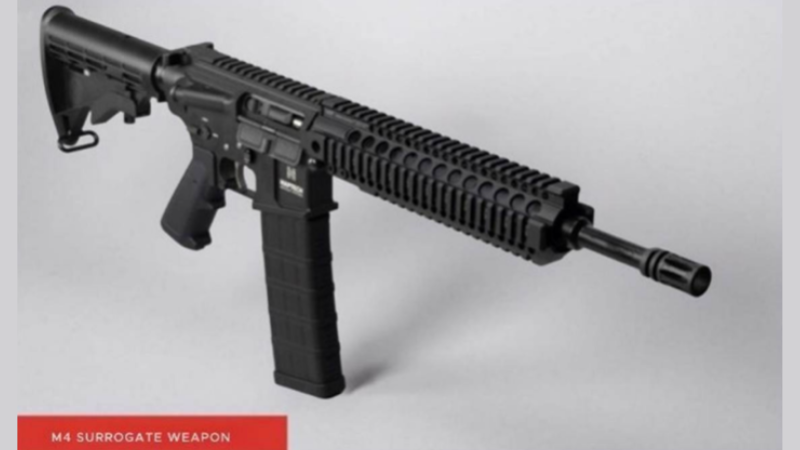
New surrogate reduces complexity and cost while increasing training capabilities and safety for U.S. military.
Nov. 28, 2025
Haptech Defense Systems is revolutionizing military training and simulation with the launch of its next-generation M4 surrogate and new data platform, Haptech Hub. Haptech’s M4 surrogate, first commissioned by the U.S. Navy, features the company’s groundbreaking and proprietary linear motor recoil system. The hub will simplify integrations with its partners and enable both Wi-Fi 6 and Bluetooth connectivity. Haptech’s M4 and Hub make their commercial debuts December 1 at the Interservice/Industry Training, Simulation and Education Conference.
The M4 and Hub commercial launches follow Haptech’s multiple military research and development contracts, which were among $17 billion in Department of Defense and Coast Guard projects and military-related economic activity in Louisiana in 2024, breaking all state records for defense-related spending.
“Haptech’s warfighter training tools are the future for commercially available, rugged and realistic combat simulation, using linear motors in ways that have never been done before,” said Haptech founder and CEO Kyle Monti. “Haptech Hub adapts our training arsenal for limitless scenario inputs and provides immediate performance feedback and training metrics. We are the disrupters the Department of Defense has been waiting for.”
Haptech’s tools deliver a level of weapon skills development that eliminates problems that plague pneumatic surrogates, blank rounds and other electronic models. For example, pneumatic systems restrict mobility and realism due to hoses or compressed air filling stations, which also add significant infrastructure cost. Blank rounds pose safety hazards and foul the weapon, creating substantial recurring expenses. Other available electronic recoil systems often fail to simulate the realistic recoil mass of true weapons, lack data-collection capability or introduce negative training and the ability to cheat the device.
Haptech invested three years of testing and refining the M4 prototype, incorporating extensive customer and soldier feedback. Ongoing input from the U.S. Army and Marine Corps validated the system’s ability to replicate authentic weapon behavior while lowering cost and risk. As a result of this solutions-based approach, Haptech’s M4 surrogate delivers untethered freedom of movement and precise recoil to replicate real-world conditions, enhance muscle memory and improve tactical decision-making — all in a scalable, adaptive and cost-effective training surrogate. The M4 surrogate achieves dynamic, repeatable recoil with battery power that fits into the product’s design without limitations, while Haptech Hub addresses the need for real-time training feedback and scenario adaptability.
“At Haptech, we design technology to solve problems, and with this M4 surrogate and Haptech Hub, we are overcoming challenges that have plagued military training simulation for decades and still persist in all other surrogates on the market today,” said Haptech chief operating officer, Conrad Rolling. “Haptech’s products are the only tools that eliminate these issues, while also meeting the Department of Defense’s immediate need for surrogates ready for deployment in any training environment.”
While the M4 marks the first COTS surrogate to include Haptech’s proprietary systems, the New Orleans-based tech company has also created electronic and motor-driven haptic surrogates and drop-in kit prototypes for the M17 and M18 small arms, M4 and M110 rifles, and M249, M240, M2 and Mk19 belt-fed machine guns. All of these weapon simulators connect to Haptech Hub to provide a rich data stream through Haptech’s open API. Future Hub features, including predictive maintenance and enhanced data streams, are planned for release in 2026.
People who read this article also found these articles interesting :





INDUSTRY NEWS


