


TOPICS & CATEGORIES
By Cassidy Mills, Senior Staff Writer
September 30, 2026
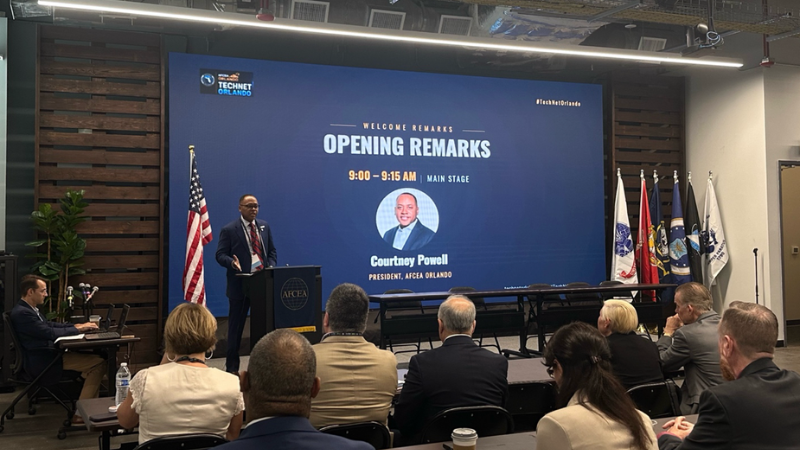
Collaboration took center stage at the inaugural TechNet Orlando, hosted by the Armed Forces Communications & Electronics Association International (AFCEA) Orlando chapter, where defense, industry and academic leaders gathered Sept. 17 at Central Florida Tech Grove to explore emerging technologies and approaches to strengthening warfighter readiness.
The one-day event brought together more than 180 attendees for discussions focused on emerging technologies, cybersecurity, artificial intelligence, simulation and ways industry and government can work together to deliver capabilities to the warfighter faster.
Courtney Powell, president of AFCEA Orlando, opened the event by reflecting on the two-year effort to establish the chapter and bring TechNet to Central Florida.
“After a two-year journey, I’m happy to see where we are today, with our very first TechNet Orlando,” Powell said. “We are excited about this inaugural event today.”
The opening keynote was delivered by Lee James, deputy capability program executive for the U.S. Army’s Capability Program Executive for Simulation, Training, Test and Threat (CPE ST3).
He described Central Florida as a uniquely positioned defense and technology community, particularly because of its concentration of modeling, simulation and training organizations.
“When you talk about modeling, simulation and training, this is it. This is the center of the universe,” James said. “This is the community where government, military, industry and academia truly do work hand in hand, side by side, day in and day out, to imagine, create and deliver the future of training to the United States Army and the joint force.”
He also discussed efforts within CPE ST3 to converge live and constructive training capabilities, modernize combat training centers, expand the use of synthetic training environments and incorporate artificial intelligence into training and simulation.
James said the goal is ultimately to give soldiers more realistic, adaptable training while reducing the time required to deliver new capabilities.
“We owe them that overmatch,” James said. “This is our generational moment. This is our inflection point. So let us keep the soldier in the center and build toward the future of warfighter readiness together.”
The event’s first panel, “Intersection of AI and Cyber,” examined the increasingly connected relationship between artificial intelligence and cybersecurity. Brian Serra, vice president of product marketing for By Light Professional IT Services, moderated the discussion.
Panelists included Gillion Helman, cyber chief technology officer and artificial intelligence officer for Cole Engineering Services; Bruce Caulkins, Ph.D., director of Cyber Solutions and Technology for Cyber Florida at the University of South Florida; and Alf Betancourt, Persistent Cyber Training Environment chief engineer for CPE ST3. The panel explored how AI is changing cybersecurity, along with the opportunities and challenges associated with incorporating AI into defense environments.
Panelists discussed the growing role of AI in cyber operations and the importance of balancing AI’s speed and capabilities with human oversight, testing and trust. Betancourt emphasized the need to carefully evaluate AI systems before using them in operational environments, including considering the potential consequences of their decisions.
“These are consequences that AI doesn’t yet understand,” Betancourt said. “I think trusting AI is important, but being able to test it somewhere first is crucial.”
The event’s first midday keynote, “Scaling Real-Time CJADC2, C4ISR & LVC Simulations: Building an Edge AI Warchest,” was presented by Ryan Fetter, senior director of the public sector at MariaDB Corporation.
Fetter discussed the technologies and infrastructure needed to scale real-time simulations and support increasingly connected operational environments, including the role of edge artificial intelligence in processing and applying information in real time.
“When we talk about real-time and enabling real-time for agentic AI, we’re talking about having data in the stream in microseconds and making decisions,” Fetter said. “We have to be thinking about real time being in less than a second; it can’t be hours, it can’t be days, the stakes are too high.”
Dan Daniels, Ph.D., chief information security officer and director of CPE ST3’s Cybersecurity Office, delivered the second midday keynote, “The Intersection of Cybersecurity Compliance and Generative AI: RMF and Automation in the Army Environment.”
The session examined how emerging AI capabilities can be incorporated while maintaining the security, compliance and risk-management requirements of the defense enterprise. Daniels noted that AI can help reduce the administrative burden of cybersecurity compliance and allow personnel to focus more on engineering and mission-focused work.
“We want to utilize some tools here that will empower the AIs to do more, that will increase capacity, but that will truly allow them to get to what we really need them to do, which is to focus on cybersecurity engineering, less on the generation of all this documentation,” Daniels said.
Three additional panel sessions throughout the event explored how training data can inform readiness decisions, how Florida’s academic research community can support defense experimentation and mission needs and how cross-sector collaboration can advance space-domain simulation capabilities.
Together, the discussions underscored the importance of connecting data, research, simulation and industry expertise to address evolving defense challenges.
Beyond the panel discussions, attendees also had opportunities to engage with exhibitors and sponsors representing technology companies, small businesses and organizations supporting the defense mission.
People who read this article also found these articles interesting :


INDUSTRY NEWS


