


TOPICS & CATEGORIES
By Shane Klestinski, Associate Editor
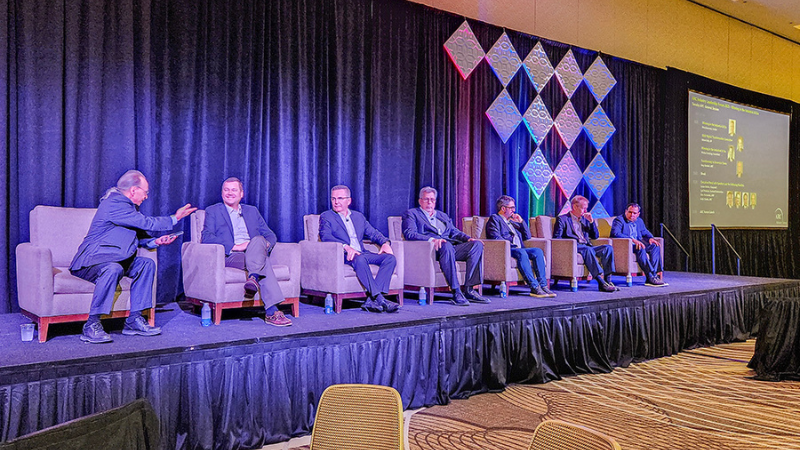
The ARC Advisory Group held its 29th Annual ARC Industry Leadership Forum, entitled “Winning in the Industrial AI Era,” in Orlando, Florida, Feb. 10-13.
Based in Dedham, Massachusetts, the ARC Advisory Group is a leading technology research and advisory firm for industry, energy and infrastructure. Its coverage of technology and trends includes areas as diverse as business systems to product and asset lifecycle management, supply chain management, operations management, energy optimization, industrial internet of things, and automation systems. The group seeks to help clients evaluate and select the best technology solutions to match their needs.
The first day of the conference concentrated on workshop sessions. The discussion-focused sessions began on the second day, Feb. 11, and featured the comments of three keynote speakers: Nico Duursema, CEO of Cerilon; Robert Kelly, vice president of digital production, projects and manufacturing at British Petroleum (BP); and Michael Hotaling, operations excellence digital manager for ExxonMobil.
Duursema began by talking about viewing the world in context and the rapid rate of change that came from three main vectors that he identified as technology, societal behaviors and industry. He explained that it was rare to see the convergence of all these vectors, “but that’s the disruptive world that we’re seeing today… it’s changing whether we like it or not.”
To illustrate his point, Duursema displayed a Venn diagram during his keynote with circles representing those three vectors. The space in the center where they overlapped represented “global disruption.” In that visual, Duursema said he saw different emotions and mindsets from different people, and he went on to address ways of adapting and thriving in a constantly changing world, emphasizing that people could look at such disruption as a challenge or an opportunity.
“Some people don’t know what’s going on, some people are actually looking forward to [the future], some people are so fearful that they don’t know what they’re fighting, and some people are just looking the other way – and that’s what we’re facing as well, how people are reacting to this environment,” Duursema said. “[Some say,] ‘I don’t want to do AI, I don’t want to change,’ [but] you can’t not look at the facts… it’s also the same with companies. You need to be very clear of what you are, what you’re not, and where you need to grow to adapt and change.”
In addition to his duties at BP, Kelly works on the Digital Transformation Committee for the International Association of Oil & Gas Producers (IOGP), which formed in 1974 in response to the OPEC crisis. He said the IOGP formed this Digital Transformation Committee of 27 active members in 2023 to deliver value across the industry by creating an open, interoperable ecosystem. Kelly addressed the IOGP’s efforts toward standardization through digital technology across the oil and gas industry, and he noted that it is “really, really difficult – but we need to deliver.” The IOGP has set up various expert groups, an overall strategy, and three key documents to achieve those ends.
“One was the five-year strategy from 2023 and 2027,” Kelly said. “The second one was on digital capabilities, so those are the use cases… for the industry. The final one was on digital skills and knowledge.”
He added that the IOGP is also looking at digital twin technology, additive manufacturing, greenhouse gas data and standards, interoperable engineering data, and the responsible use of AI to help execute its goals.
Hotaling’s talk started with a focus on digital twin technology, and he noted that interoperability must be free from custom integration. He said that his team believes that this is an area where, based on open standards, they can accelerate business value as well as opportunities for more suppliers to compete. Hotaling also discussed the advantages of technology reducing an employee’s cognitive load and the importance of data quality. He went on emphasize that improving data quality involved firms changing work practices to ensure the adequate quality of that data, as opposed to “just throwing more horsepower” at the problem.
“Let’s not just burden our employees with inundated information, but let’s make sure we give them the information where they need it, when they need it,” Hotaling said. “If we’re going to make them superhuman, we’ve got to give them the capability and the technology to change the way they work. All of this will be integrated with data… and it won’t be [from] one system. It’s open, interoperable data that can be accelerated with AI and machine learning.”
This year’s ARC Advisory Group conference featured 190 speakers and panelists, as well as more than 200 companies attending from 15 countries. The ARC Industry Leadership Forum is scheduled to return to Orlando, Feb. 9-12, 2026.
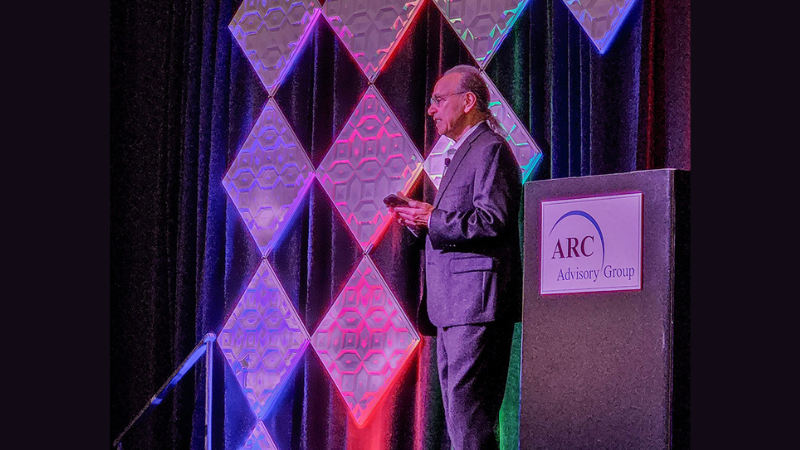
Andy Chatha, president and CEO of ARC Advisory Group, addresses attendees of the 29th Annual ARC Industry Leadership Forum.
People who read this article also found these articles interesting :



INDUSTRY NEWS


