


TOPICS & CATEGORIES
By Cassidy Mills, Staff Writer
September 30, 2026
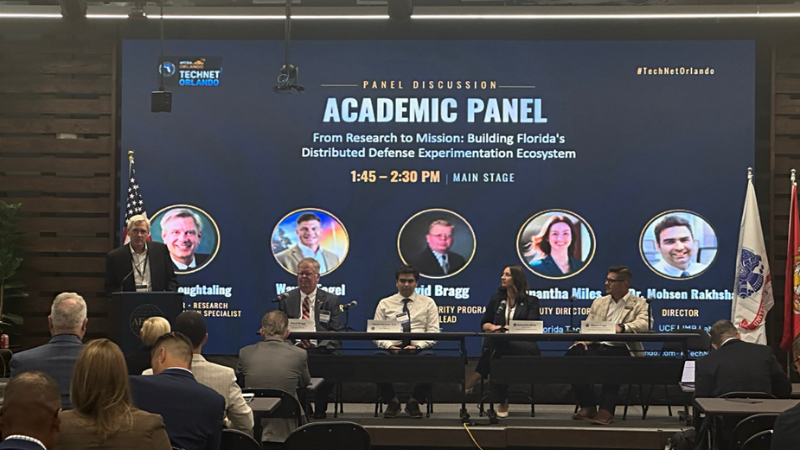
Experts from Florida’s universities, research institutions and industry discussed how the state can move emerging technologies from academic research toward operational defense capabilities during the “From Research to Mission: Building Florida’s Distributed Defense Experimentation Ecosystem” panel at TechNet Orlando on Sept. 17.
Hosted by the Armed Forces Communications & Electronics Association International (AFCEA) Orlando Chapter at Central Florida Tech Grove, TechNet Orlando brought together leaders from across the defense, technology and research communities to discuss innovation, experimentation, workforce development and collaboration.
Moderated by Chris Houghtaling, research commercialization specialist at FAU, panelists included Wayne Fogel, deputy director of the UCF Institute for Simulation & Training (IST); David Bragg, national security program area lead at the Florida Applied Research and Engineering Lab; Samantha Miles, executive director of Vertex Florida Tech’s Applied Innovation Hub; and Mohsen Rakhshan, Ph.D., director of the UCF Laboratory for Interaction of Machine and Brain and a member of the IST research faculty.
Houghtaling opened the discussion by describing the challenge of moving an idea from research into a capability that can be used outside the laboratory.
“Research commercialization is really about how you take an idea and make it deployable,” Houghtaling said. “You need to train the people who are going to utilize the information, and you need to bring together the technicians, businesspeople and others who are necessary to make that technology useful.”
Fogel said universities play an important role in defense research because they can conduct foundational work and explore technologies that industry may not have the resources to pursue independently.
“We have the capabilities to do the basic research on new technology because a lot of times industry doesn’t have the funding or the capabilities to do it,” Fogel said. “We have faculty dedicated to research, so we’re able to focus on ideas that industry may not be able to pursue on its own.”
Bragg added that universities also provide an environment where emerging technologies can be tested while researchers examine the human factors involved in using them.
“The technology is super important, but I think universities also have a role in establishing trust,” Bragg said. “We need to understand the human factors involved — when we can trust the technology, how to understand its limitations and how people are going to interact with it.”
Miles focused on the workforce required to develop and maintain increasingly complex technologies.
“We’re in a world that’s increasingly reliant on technology, and we need an ever-increasing workforce that can build and maintain that technology,” Miles said. “Workforce development is a really important part of what we need to be thinking about as we build this ecosystem.”
Miles also discussed the role of innovation hubs in connecting organizations across Florida. She said the state’s distributed network allows institutions to focus on different areas rather than duplicating the same capabilities.
“Florida, as an ecosystem, has a really distributed system of resources for our military partners and our businesses to engage,” Miles said. “We’re not all trying to do the same thing; we’re taking these focus areas and leaning into them.”
Rakhshan described research at the UCF Laboratory for Interaction of Machine and Brain involving human-machine interaction, robotics and sensory information. He said emerging systems must account for how people receive and process information when operating technologies remotely.
“How can we develop new algorithms that compress the information that’s being communicated and minimize the latency while giving you the most important information?” Rakhshan said. “The goal is to provide the person with the information they need to understand what’s happening in the environment.”
The panel also addressed the gap between research and commercialization. Panelists discussed the need to involve potential users and customers earlier in the research process so technologies are developed with practical applications in mind.
Miles said Vertex Florida Tech’s Applied Innovation Hub was designed to bring capabilities such as digital engineering, prototyping, testing and workforce development together in one location.
“Our partners told us that if we had a one-stop shop where we could design something, build it quickly, test it and then fix what’s wrong with it and iterate, that’s really what we need,” Miles said. “That’s what we invested our resources in and what we’re continuing to build.”
The discussion shifted to the changing pace of defense technology development and the need for universities to work more closely with industry and government. Fogel emphasized organizations increasingly need to collaborate from the beginning of a project rather than waiting until research has reached a later stage.
“The best success is working as an academic partner with other academic partners and industry partners together,” Fogel said. “We’re able to iterate from the start, continuously work on the problem and change it as we learn.”
At the same time, panelists emphasized that faster development timelines should not come at the expense of basic and fundamental research. Rakhshan said some research requires years of work before it can produce a practical capability, particularly in areas involving neuroscience and human-machine interaction.
“Basic and fundamental research has to stay the way it is, no matter how the requirements for turnaround are or how AI is changing things,” Rakhshan said. “There are things we need to be doing not for six months, but for 10 years, that can change how we do things for the next 50 years.”
The panel also highlighted the importance of maintaining a connection between basic research, applied research and eventual operational needs. Fogel pointed to defense applications that have relied on fundamental research conducted years before an immediate operational requirement emerged.
“Technology and innovation are great, but you still have to be able to execute and do the basics,” Fogel said. “We have to combine the technology, the human use and execution, and the training and development of the people who are going to use those capabilities.”
Panelists also highlighted current opportunities for collaboration across Florida, including in autonomous systems, artificial intelligence, robotics, advanced manufacturing and distributed experimentation.
Bragg said one area of focus is developing autonomous systems capable of processing information at the edge rather than relying entirely on centralized computing.
“We’re looking to push AI to the edge in ground, air, maritime and space domains,” Bragg said. “We’re looking to establish a consistent research ecosystem so we’re not rebuilding the research enterprise every time we start a new project.”
People who read this article also found these articles interesting :


INDUSTRY NEWS


