


TOPICS & CATEGORIES
By Mason Gray, Staff Writer
September 30, 2026
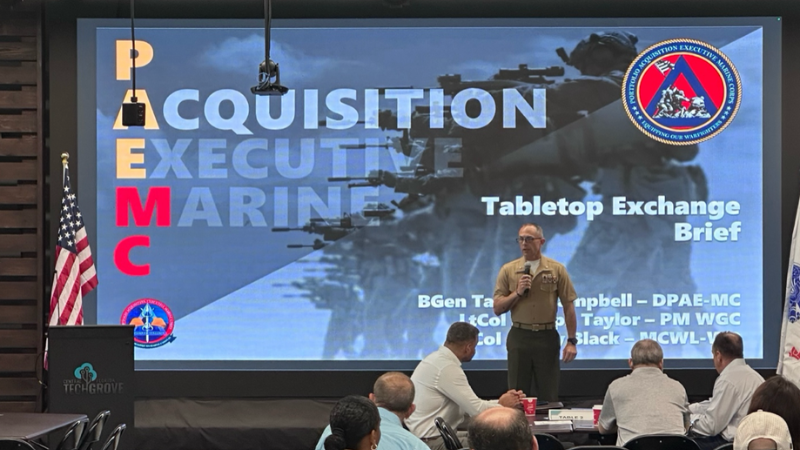
The United States Marine Corps brought government and industry experts together at Central Florida Tech Grove on Sept. 11 to explore technologies aimed at making its future wargaming capabilities more scalable, repeatable and transparent.
Hosted by the Marine Corps Systems Command Program Manager for Wargaming Capability (PM WGC), the Tabletop Exchange gave participants insight into an upcoming Wargaming Prize Challenge and the technical challenges the Marine Corps is seeking to address.
Lt. Col. Joseph Taylor, program manager for Wargaming Capability, said the event was designed around problem-solving and collaboration, with participants divided among tables to discuss their organizations’ capabilities, identify potential contributions and explore partnership opportunities.
The Marine Corps is seeking a next-generation ecosystem capable of integrating distributed modeling and simulation, wargaming and analytical tools. Taylor said lessons from previous efforts helped the service identify three key areas for improvement.
“The Marine Corps currently lacks a scalable, repeatable and transparent wargaming capability,” Taylor said.
Repeatability is particularly important for analysis. He added that simulations need to be capable of running thousands of times within short periods to build confidence in potential outcomes rather than relying on a limited number of iterations.
That need for reliable analysis also underscores the importance of transparency, as results produced through wargaming can ultimately inform decisions about capabilities and resources. The proposed approach also emphasizes an open architecture that would allow different tools and technologies to be integrated into the wargaming environment.
Taylor emphasized that the Marine Corps wants the flexibility to bring different solutions into the ecosystem as requirements and technologies change rather than remain tied to a single solution. That flexibility could allow different companies to contribute specialized capabilities instead of requiring one system to perform every function.
“If you’re already a hammer, don’t try to be a screwdriver up here, thinking that the screwdriver is going to win,” Taylor said. “Just be a really good hammer and tell me how I can put you in my toolbox.”
The Marine Corps is also seeking capabilities that can be put to use quickly. When asked about the desired timeline for potential technologies, Taylor stressed the urgency.
He added that companies with technologies requiring additional development should continue working on them because the Marine Corps intends for the ecosystem to evolve as new and improved capabilities become available.
Brig. Gen. Tamara Campbell, commanding general of Marine Corps Systems Command, said the service initially pursued a traditional materiel solution but found that approach too expensive and lacking the agility to integrate rapidly advancing technologies such as artificial intelligence and enhanced cybersecurity.
Campbell said 18 months of market research indicated that potential solutions may already exist within industry.
Participants in the upcoming challenge will compete for a share of $1.99 million, with potential eligibility for a direct award under the Software Acquisition Framework.
“The objective is a long-term partnership to help build the future of the Marine Corps’ preeminent wargaming capability and to get the tools in the hands of our Marines,” Campbell said.
The Tabletop Exchange also introduced participants to the Marine Corps’ seven-step wargaming process: define, scope, design, develop, rehearse, execute and assess.
Lt. Col. Scotty Black, senior AI and modeling and simulation technical adviser with the Marine Corps Warfighting Laboratory’s Wargaming Division, said the wargame itself is not the ultimate product.
“The wargame is a means to get to the end,” Black said. “The end is an analytic finding that moves the Marine Corps, the joint force, forward.”
The South China Sea Crucible – an unclassified, multidomain scenario – will provide a common environment for evaluating how different capabilities perform during the upcoming challenge.
Black said the Marine Corps is not currently mandating one architecture or standard for the ecosystem and instead wants to see what industry can provide.
“It’s an ecosystem,” Black said. “We would like to solve the entire seven-step process, likely using different tools.”
People who read this article also found these articles interesting :


INDUSTRY NEWS


