


TOPICS & CATEGORIES
By Cassidy Mills, Senior Staff Writer
October 14, 2026
The National Center for Simulation (NCS) inducted three distinguished leaders into its 2026 Modeling & Simulation Hall of Fame (M&S HOF) on Sept. 30 at the Orange County Convention Center, recognizing decades of innovation that have helped shape military training, medical simulation and immersive technology.
Merry “Beth” Pettitt, Ph.D., Robert Sottilare, Ph.D. and Kay Stanney, Ph.D., were honored for their contributions to modeling, simulation and training (MS&T), a field that plays a critical role in military readiness, health care, aviation and academia.
Established in 2014 in partnership with Orange County Government and the Orange County Convention Center, the M&S HOF recognizes individuals whose achievements have advanced modeling and simulation over the past century. The inductees join a distinguished group of pioneers whose work has helped establish Central Florida as a global hub for simulation and training.
Broadcast on Orange TV, the ceremony brought together family members, colleagues, industry leaders, military representatives and previous M&S Hall of Fame inductees to celebrate the three honorees and their lasting impact on the modeling and simulation community.
George Cheros, president and CEO of NCS, highlighted the importance of preserving the industry’s history while inspiring future innovators.
“The wall honors the best of the best, their dedication, their contributions and the legacy they will leave behind,” Cheros said. “A legacy that will continue to inspire those who follow.”
Neal Finkelstein, chief operating officer of NCS, also recognized the broader teams and partnerships behind the inductees’ achievements.
“The inductees tonight did more than imagine what was possible,” Finkelstein said. “They helped make it possible.”
Pettitt was recognized for more than 30 years of leadership in military medical simulation and her work transforming how military medics prepare to treat battlefield injuries.
Her contributions span combat trauma simulation, full-body mannequins, task trainers, simulated wounds, physiology modeling and training effectiveness evaluation. Pettitt’s work helped establish approaches to using simulation within the Department of Defense that balance realism with practical training requirements.
During the ceremony, colleagues highlighted Pettitt’s leadership in bringing together government, industry and academic researchers to develop more effective medical training capabilities. These advances have helped military medical personnel practice complex procedures, strengthen decision-making and improve their preparation for real-world emergencies.
In her acceptance remarks, Pettitt reflected on the experiences that shaped her work highlighted as a researcher and educator.
“There have been so many moments out in the field with soldiers that have inspired me to make military medical training better,” Pettitt said. “What if we could provide meaningful feedback right after a training event?”
She also reflected on the evolution of medical simulation, from early training devices to wireless manikins, realistic tissue and wound representations, automated assessments and extended-reality environments.
Her induction recognizes both her technical accomplishments and her leadership in advancing medical simulation capabilities that support military personnel and improve patient care.
Sottilare was honored for his contributions to simulation technology, standards and education. His research helped lay the groundwork for Distributed Interactive Simulation (DIS) and contributed to the landmark 1994 Synthetic Theatre of War–Europe exercise, helping establish the foundation for today’s live, virtual and constructive training environments.
Sottilare’s later research focused on the Generalized Intelligent Framework for Tutoring (GIFT), an open, interoperable architecture designed to support intelligent tutoring and adaptive training. His work helped establish pathways for applying artificial intelligence (AI) to training systems that can respond to individual learners’ needs.
During his acceptance remarks, Sottilare credited the mentors, colleagues and teams who shaped his career across government, academia and industry. He also offered advice to emerging researchers and innovators, encouraging them to focus on meaningful problems and work collaboratively toward solutions.
“I want to close by challenging the next generation of engineers, scientists and innovators,” Sottilare said. “Keep pushing the boundaries of what’s possible by understanding the problems you want to solve, prioritizing the tasks that will get you there, learning from great people and taking action.”
Although he is transitioning into retirement, Sottilare plans to remain involved in the M&S community through consulting, technical advising and continued support for professional conferences and research initiatives. His induction recognizes contributions that continue to influence the evolution of simulation architectures and training systems.
Stanney was recognized for pioneering research in immersive simulation, human factors and the effects of virtual environments on human performance. Her work on simulator sickness, perception, sensory conflict, latency and cognitive workload has influenced simulation design across defense, health care, aviation and commercial applications.
Her career has combined academic research, industry leadership and technology development. Stanney’s work at the University of Central Florida helped advance understanding of how people interact with immersive environments, while her leadership at Design Interactive helped translate research into practical solutions.
Her contributions include research and development involving neurophysiological sensing, adaptive human-machine teaming, performance-based training, AI-driven assessment, eye tracking and digital twin technologies.
In her acceptance remarks, Stanney reflected on a career shaped by creating technology and helping people discover their capabilities. She emphasized that advances in simulation should be guided by a deep understanding of human needs and limitations.
“The future of modeling and simulation isn’t just about more powerful technology, but a deeper understanding of people,” Stanney said. “Technology should fit people, not the other way around.”
Stanney also recognized the mentors, colleagues, students, collaborators and employees who contributed to her career, underscoring the importance of teamwork and mentorship in sustaining innovation.
She said emerging AI capabilities offer new opportunities to personalize training and adapt systems to individual users, while cautioning that technological capability alone does not guarantee that a system will effectively serve people.
The ceremony highlighted the importance of the modeling and simulation industry to Central Florida and the broader defense community. The region’s concentration of military organizations, academic institutions, technology companies and industry partners has helped establish it as a major center for simulation and training.
The Orange County Convention Center’s Modeling and Simulation Wall of Fame provides a prominent setting for recognizing that legacy. The display is viewed by convention attendees, military and industry leaders, students and professionals from around the world.
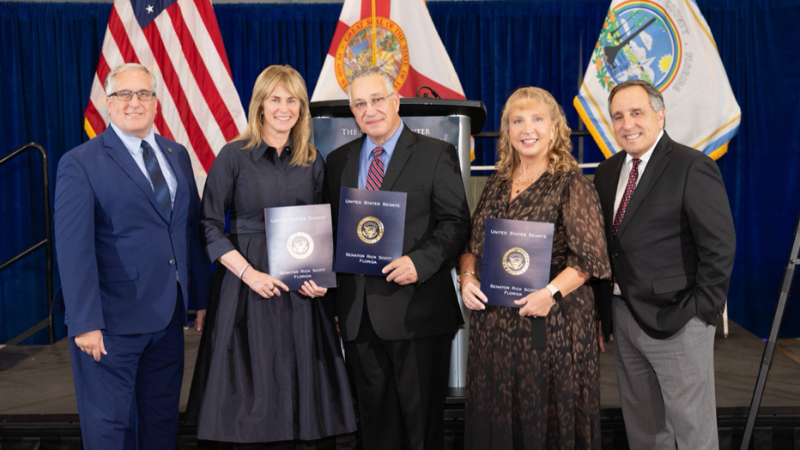
Letters of congratulations from Florida’s congressional delegation and representatives of the U.S. Senate were presented in recognition of the inductees’ accomplishments and their contributions to American innovation and the modeling and simulation industry.
The 2026 ceremony marked the induction of the M&S HOF’s 13th class, adding three more names to a legacy that stretches back to the early development of aviation training simulation.
Speakers emphasized that the achievements recognized by the M&S HOF reflect the work of entire teams, including researchers, engineers, educators, government employees, industry partners and military professionals.
People who read this article also found these articles interesting :


INDUSTRY NEWS


