


TOPICS & CATEGORIES
January 10, 2026
By Cassidy Mills, Staff Writer
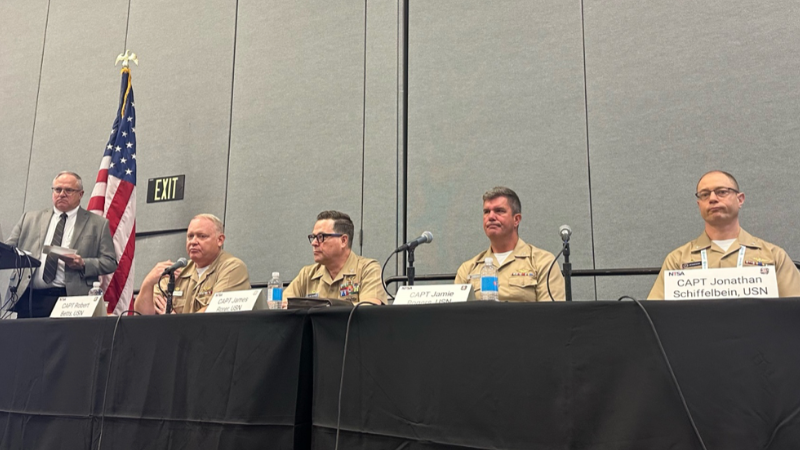
The Navy Vision from Training Systems Program Managers panel at the Interservice/Industry Training, Simulation and Education Conference (I/ITSEC) showcased emerging technologies, outlined strategic priorities and shared lessons learned from operational experience, Dec. 4.
I/ITSEC is the world’s largest modeling, simulation and training (MS&T) event, held annually the week after Thanksgiving at the Orange County Convention Center in Orlando, Fla. The conference brings together the global MS&T community for a full week of demonstrations, discussions and collaboration.
Each year, the event draws thousands of MS&T professionals, including senior civilian and military leaders, C-suite industry executives and distinguished academic researchers from leading institutions.
Moderated by Mike Merritt, acquisition director at the Naval Air Warfare Center Training Systems Division, the session provided insight into how Navy program managers are advancing training solutions and addressing the operational challenges faced by sailors and aircrew.
Panelists included Capt. Robert Betts, commander of the Naval Air Warfare Center Training Systems Division; Capt. James Rorer, program director of the Training Systems & Simulation Program Management Office, F-35 Joint Program Office; Capt. Jamie Rogers, director of the Career Training Continuum, PEO Manpower, Logistics and Business Solutions; and Capt. Jonathan Schiffelbein, program manager of PMA 205.
“The Navy is really pushing the limits of simulated training to meet mission requirements efficiently,” Betts said. “With aircraft limited in number and costly to operate, simulated environments allow pilots to practice mission sets repetitively, reducing wear on the aircraft while enhancing readiness.”
Betts emphasized the human element of training, noting that developing real-world skills requires more than technology, and illustrated his point by comparing flight training to a new driver learning through video games to pilots training in simulators.
“You can get realism, adrenaline and muscle memory in a simulator,” Betts said. “But until you feel the aircraft under your control, there’s an element that only real-world experience provides. That’s why live, virtual and constructive training is so vital for the Navy.”
Panelists underscored the transformative role of simulation in both pilot and maintenance training. Rorer described efforts to field modified mission rehearsal trainers and the Phoenix system –smaller, cost-effective and deployable simulators tailored for F-35 training.
“The only way our pilots and maintainers can get relevant, repeatable training in today’s environment is through advanced simulation,” Rorer said. “These smaller-footprint systems allow us to focus on specific mission sets, rehearse critical procedures and train safely, efficiently and repeatedly.”
The discussion also addressed acquisition and workforce adaptation, particularly with evolving policies such as the potential changes in the Acquisition Decision Joint Approval Committee process.
“We’ve been given the authority to rework acquisition processes, bend guidelines where appropriate and reduce delays,” Merritt said. “It’s about moving quickly while maintaining quality and readiness.”
Merritt also addressed strategic priorities for the Navy’s Training Systems Division: speed, training at the point of need and interoperability. He highlighted the importance of rapidly delivering flexible, connected training solutions to meet fleet requirements.
“We must shorten timelines from development to delivery and ensure that training systems are fully interoperable with other platforms and joint services,” Merritt said. “This creates a digital sandbox environment where new capabilities can be tested before reaching the fleet.”
A recurring theme throughout the session was balancing simulator fidelity, program costs and learning outcomes to ensure training remains efficient and mission-focused. Rogers said the goal is to streamline requirements while maintaining quality and readiness across programs.
“You don’t always need the most technologically advanced simulator for basic tasks,” Rogers said. “Training should be designed around the learning objective, not the technology itself. Focus on what needs to be learned first.”
Rogers said the Navy must carefully balance its need for rapid access to training data and system adaptability with industry’s need to maintain profitable operations and continue investing in innovative solutions.
“We need the ability to compete and adapt, but industry needs to make money too,” Rogers said. “The challenge is finding a model where the Navy can access the data it needs to move fast while industry still benefits. Think of it like a 3D-printing iTunes model — pay per use but maintain access.”
Looking ahead, Schiffelbein emphasized the importance of establishing feedback loops that allows the Navy to evaluate and refine its training programs based on fleet performance and evolving operational needs.
“Gaps will always exist, but we can learn from mistakes, see what works in the fleet and make adjustments quickly,” Schiffelbein said. “The goal is a force that is ready and capable from day one of any operation.”
People who read this article also found these articles interesting :




INDUSTRY NEWS


