


TOPICS & CATEGORIES
By Shane Klestinski, Associate Editor
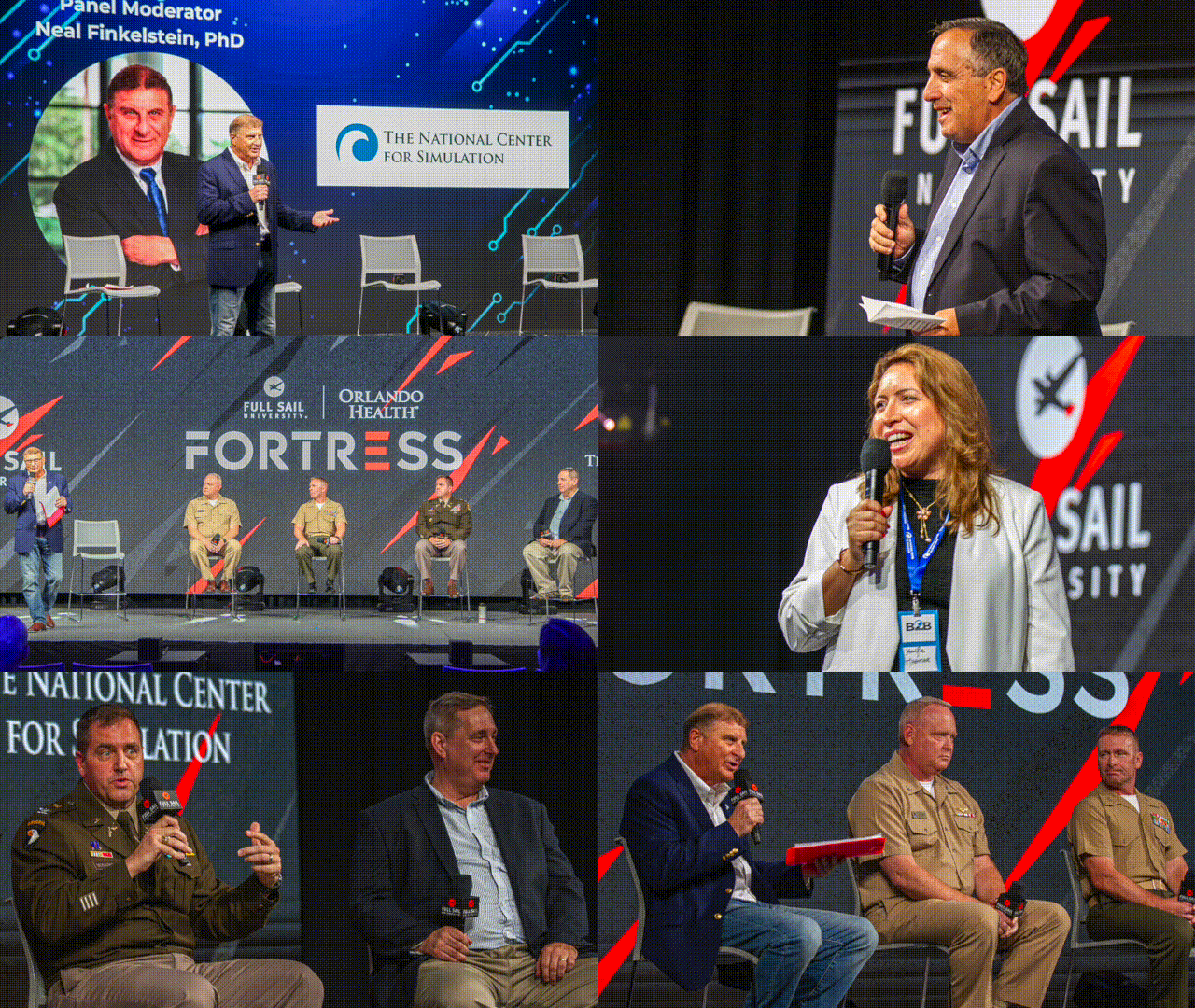
Professionals of Orlando’s modeling, simulation and training (MS&T) community gathered for the National Center for Simulation’s (NCS) Annual Business-2-Business Event for a night of socializing and networking at Full Sail University, Sept. 19.
The event’s agenda also included a panel discussion featuring senior leaders representing Team Orlando’s military organizations, who addressed significant trends in the MS&T space.
Neil Finkelstein, Ph.D., NCS chief operating officer, moderated the panel. Discussion participants included Navy Capt. Robert Betts, executive officer of the Naval Air Warfare Center Training Systems Division; Marine Col. Marcus Reynolds, program manager for Program Manager Training Systems; Army Col. Thomas Monaghan, project manager with Program Executive Office for Simulation, Training and Instrumentation; and Brett Telford, the Air Force Agency for Modeling and Simulation’s deputy director.
Finkelstein began the discussion emphasizing the significance of the Central Florida Tech Grove in the MS&T space, and he asked the panel members about benefits Tech Grove provided.
Monaghan noted that one of industry’s greatest frustrations in the past had involved communication with the government, specifically, “How do I talk to you?” Industry participants did not want to write white papers just to ask a question, and they didn’t want to risk losing original ideas to a competitor by asking a question that revealed too much in a public forum. According to Monaghan, these businesses only wanted to show what they could do and get feedback.
“Fast forward about 15 years later, and that’s what Tech Grove is facilitating for the Department of Defense,” Monaghan said. “[In my position,] I have multiple vendors coming in and saying, ‘I have a better idea of how to attack this problem or address this issue,’ and without Tech Grove, I wouldn’t have that opportunity to pull them in without laborious and lengthy statements of work, requests for information, et cetera.”
Next, Finkelstein asked about issues presented by the work-at-home environments in the industrial base that technology could help.
“The [positive] thing that happened from COVID was that we adopted a lot of technology very quickly at the DOD, it pushed us ahead five to 10 years of where we would normally be at this point because the tools were not there,” Reynolds said. “People learned different ways to get things done. Can you replace being in the same room and reading body language through Teams? No, but can you be more productive and make more impact with the technology we have today? Absolutely, and we’re going to get better.”
Betts said that one of the Navy’s COVID realizations was that personnel did not always have to be at a training center to do training, but he also emphasized the importance of a technology’s interoperability with other systems.
“They have to be interoperable upon delivery,” Betts said. “You can deliver the best system in the world, but if it can’t talk to the rest of the systems… it’s of very limited utility to us.”
When the panel addressed live-virtual-constructive (LVC) training, Telford explained that today’s security concerns were not necessarily “near-peer threats.” Sometimes, they were actual “peer threats,” particularly in the larger numbers of people that adversary countries have in uniform and the modern-day distances involved in weapons-employment zones.
“The only way we’re going to be able to train airmen to standard is using LVC-distributed networks, whether that’s because we can’t train to standard on our range complexes, or because to do so would make things we don’t want in open air, to be in open air, or because using those capabilities would damage civilian infrastructure,” Telford said. “The only way we can train is in some kind of mixed LVC reality. Whether it’s here in Florida, out at Nellis, whether it’s an Air Force fight or a joint fight – which is the way we go to war – we’re going to need those capabilities.”
Later in the discussion, Finkelstein mentioned the Space Training and Readiness Command’s (STARCOM) permanent move to Florida, which officials announced earlier this year. STARCOM is the Space Force’s education, training, doctrine and test field command. This topic also brought up a public update to Team Orlando’s roster.
“Space Force is officially a Team Orlando member now,” Betts said. “That is official as of today. STARCOM is currently working with Team Orlando and Tech Grove to figure out how to start hosting their own PALTs [procurement administrative lead time sessions]. From an industry-engagement perspective, that will help Space Force get plugged into the ecosystem that we have with Team Orlando, Tech Grove, and all the NCS entities.”
Finkelstein said the evening’s event was about getting businesses in industry together with the military to understand their challenges and some of their strategic missions going forward – while staying away from contract questions.
“A lot of the time when [modeling and simulation] folks get together, conversation goes toward contracts and delays in contracts, but tonight was more about strategy, technology and where we’re going in the future on important issues,” Finkelstein said.
The NCS’ next major event will be its Modeling and Simulation Hall of Fame induction ceremony at the Orange County Convention Center, Oct. 23. Attendance is free but registration is required. Click here for more information.
People who read this article also found these articles interesting :


INDUSTRY NEWS


