


TOPICS & CATEGORIES

By Cassidy Mills, Staff Writer
September 12, 2025
Students across Central Florida spent their summer building robots, exploring medical simulations and discovering new career paths in science and engineering through the National Center for Simulation’s (NCS) Gains in the Education of Math and Science (GEMS) summer camps.
Held in week-long sessions from June 2 to July 25, the camps welcomed middle school, high school and college students to explore careers in science, technology, engineering and math (STEM).
Each program combined experiential learning with mentorship from subject matter experts across the modeling, simulation and training (MS&T) community. NCS camps were hosted in collaboration with the Army Educational Outreach Program, DoD STARBASE Central Florida, the University of Central Florida and other Team Orlando partners.
Lindsey Spalding, director of workforce development and DoD STARBASE Central Florida at NCS, said the goal is to give students meaningful, hands-on experiences that connect directly to real-world opportunities.
“Our focus is to give students insights into STEM-related fields by offering opportunities for them to experience technology,” Spalding said. “From robots to holograms, students gain a level of exposure that sparks curiosity and, ultimately, builds confidence to pursue these fields further.”
Spalding added that mentorship is another cornerstone of the GEMS model, with experts from the military, government, academia and industry helping students explore diverse careers and imagine new possibilities.
“The mentors are the bridge between classroom learning and real-world application,” Spalding said. “When students see someone who looks like them, or someone doing work they never thought was possible, it changes their perspective entirely.”
This year’s offerings included two main themes tailored to different age groups. Middle school students attended “Into the Barbieverse!” on UCF’s campus, where they explored the many STEM-related careers Barbie has held, with support from familiar characters like Hello Kitty, Minecraft’s Steve and Alex, and the islanders of Animal Crossing. The program encouraged participants to see how technology and problem-solving can be part of everyday life.
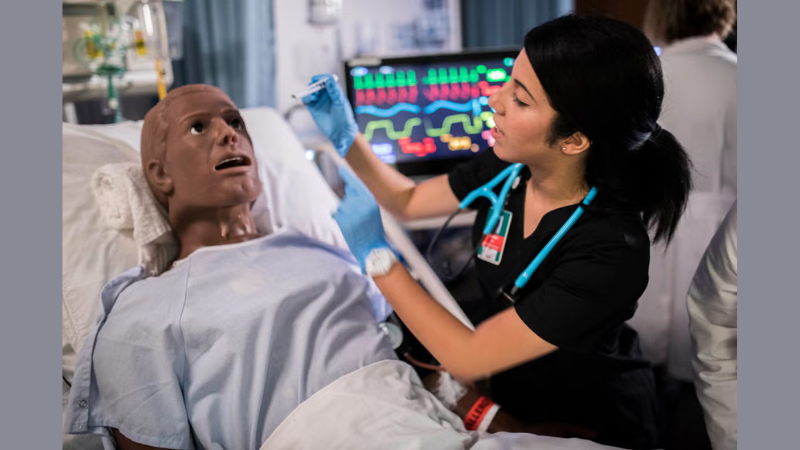
High school students joined “Into the Mediverse!” at DoD STARBASE Central Florida. Designed for students new to NCS programs or those who had already attended multiple camps, the session emphasized leadership skills and STEM applications in healthcare. Activities included simulation-based medical training, such as “STOP THE BLEED,” along with presentations from medical and defense experts.
Abbie Easter, NCS program coordinator, said the program expanded into Osceola and Seminole counties to reach disadvantaged students who may not otherwise have access to STEM-focused opportunities.
“Accessibility is central to what we’re trying to accomplish,” Easter said. “By adding camps in Osceola and Seminole counties, we’re reaching students in areas where these kinds of experiences haven’t always been available. We want them to know STEM is for everyone, and that opportunities in these fields are open to them.”
The expansion reflects a broader commitment from NCS and its partners to strengthen the talent pipeline in Central Florida and beyond. Easter said the camps not only teach technical skills but also highlight teamwork, creativity and problem-solving as essential parts of STEM careers.
“We don’t just want students to attend one week and leave it behind,” Easter said. “We want to create a pathway where they return year after year, grow into leadership roles as ‘Near Peers,’ and eventually see themselves as part of this professional community.”
George Cheros, president and CEO of the National Center for Simulation, said the camps showcase the best of what the MS&T community can achieve when organizations come together.
“We’re not just giving students a week of fun activities; we’re helping them see a future in science and engineering, while also preparing the workforce of tomorrow,” Cheros said. “The fact that we are reaching new and underserved areas this year makes the impact even more significant.”
Cheros added that the long-term goal is to align student curiosity and emerging skills with regional workforce needs, equipping the next generation to thrive in Central Florida’s growing simulation and training sector.
“Central Florida is a global hub for simulation and training,” Cheros said. “By investing in programs like GEMS, we’re nurturing homegrown talent that can contribute locally and drive continued innovation in the industry.”
People who read this article also found these articles interesting :


INDUSTRY NEWS


