


TOPICS & CATEGORIES

By Shane Klestinski, Associate Editor
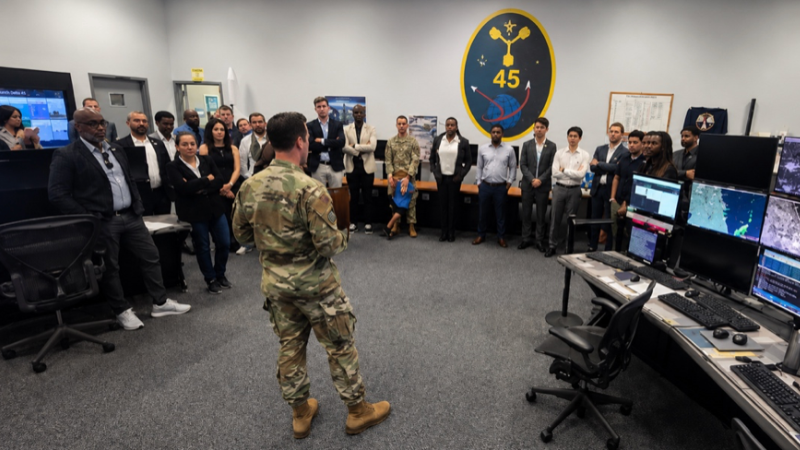
Army Col. Jason West assumed duties as the new director of Synthetic Training Environment – Cross Functional Team (STE-CFT) in Orlando, Florida, Aug 12.
Originally from Steelville, Missouri, West attended Lincoln University. When he matriculated, the school required all male freshmen to attend ROTC classes. He was already looking to join the military when the curriculum exposed him to rappelling, marksmanship and “all the fun stuff” that came with the camaraderie of a military environment. Realizing that the Army had a lot he could learn from and contribute to, West began his active-duty journey in 1998 after graduating with a bachelor’s in accounting and commissioning as an Army aviation officer.
His first assignment took him to Camp Stanley, Korea, with 2nd Battalion, 2nd Aviation Regiment, where he served as Command Aviation Platoon leader. Since then, West has led soldiers in billets from the platoon level to brigade command. His previous staff positions have put him in the roles of operations officer, executive officer, chief of staff, and director. Overall, he has served in the 101st and 82nd Airborne Divisions, as well as the 1st, 2nd, 3rd and 4th Infantry Divisions, leading up to his current role at STE-CFT.
West has three combat deployments. He served in Iraq as a light infantry brigade aviation officer on the ground from 2006 to 2008, and later as an air assault battalion operations officer and executive officer in the air from 2010 to 2011. He deployed again to Bagram Airbase in Afghanistan from 2012 to 2013 with the 1st Infantry Division as future operations officer.
As an aviator in operational flight units, West served as a pilot-in-command, an air mission commander, and a maintenance test pilot, accumulating over 1500 flight hours in Bell 206 Jet Rangers, OH-58 A/C Kiowa Warriors, and UH-60 Blackhawks. Since transitioning to senior leadership and assuming the associated duties, he has not flown military aircraft for some time, but he misses “100% of all of it.”
“What I bring to the table now is my experience as an aviator, which involves a lot of simulators,” West said. “I’ve sat in a lot of simulators, and in this job, I see even more simulators. [Now, I think about] how many platforms can I get a crew into [for training in] a virtual environment to work alongside an Abrams [tank] or a Bradley [fighting vehicle] in combined arms maneuver collective training.”
Since earning his undergraduate degree, West has also received a master’s in national security strategy from the National War College at Fort McNair, Washington, D.C., and he holds a certification in capability development, and a “Level D” certification in requirements management from the Defense Acquisition University. West’s military training and education background includes the Army Aviation Officer Basic and Initial Entry Rotary Wing courses, as well as Basic Airborne and Air Assault schools.
West credits his operational experience, as well as three specific billets, which have prepared him for his current role the most by teaching him what he calls the “three decision-making processes of the Army.”
While all soldiers start earning operational experience in the junior ranks, according to West, there is a time in everyone’s career when they begin to pivot to “how the Army runs,” and that is where they enable the Army’s conduct of those operations. West received “a study in resourcing national security” when he became the executive officer of the Program Analysis and Evaluation Directorate of the G8 at the Pentagon.
“Being an XO, working with the general officer in charge of that organization, and getting to observe how we program the Army’s future year’s defense plan, I thought it was amazing,” West said.
Afterwards, West reported to the Studies Analysis and Wargaming Division in the Joint Staff J8, where his focus shifted to wargaming to help inform requirements.
“The organization I led concentrated on seminar-style, political/military science wargames,” West said. “I got to work with a lot of agencies and departments in thinking through the application of the four instruments of national power: diplomatic, information, military, and economics (DIME). Those factors not only help the chairman of the Joints Chiefs of Staff perform his duties as principal military advisor to the president, [but] we also utilized the results of the wargames to inform the requirements process of the Joint Requirements Oversight Council, which we were adjacent to. We would even bring in industry, and you might have the CEO of an organization like Google in the room… to help inform with where we were in accordance with DIME as we were looking at a certain problem.”
Most recently, West was the Training Doctrine Proponent Office-Synthetic Training Environment director in Fort Leavenworth, Kansas, which he described as “capability management.” As director, he integrated the Army Training Doctrine (TRADOC) office’s equities of training aids, devices, simulators and simulations for the synthetic environment across the live, virtual and constructive components. Despite the authoritative job title, West said he wasn’t actually “in charge” in the traditional, military sense. His role focused more on integration.
“I had a fellow O6 who was over the constructive environment, another O6 who was over the live environment, and I had the virtual environment below me,” West said. “My job was to help integrate all that in capability management, as the ‘day job’ of that organization had to do with proven capabilities, or ‘legacy’ as we call them now.”
In his new post in Orlando, West leads a team consisting of military personnel, Army civilians, and contractors who work to modernize the Army and prepare soldiers for potential conflicts with near-peer adversaries. His team focuses heavily on integrating today’s innovations in human-machine integration, robotics, artificial intelligence, and synthetic training environments for future military operations. According to West, his current job involves identifying gaps to help requirements managers formulate them into a document that goes to a material developer to see the solutions available in industry.
“If you ever have the opportunity to work in a similar portfolio, take it,” West said. “In the Army, we rotate every couple of years, so I’m very happy to continue in this portfolio but also see it from another angle. Based on the experiences I’ve had across the three decision-making processes of the Army, it’s exciting, not only to continue developing myself, but also helping to inform those requirements for our soldiers.”
Since taking charge of STE-CFT, West now emphasizes the need for his organization to continue moving ahead in modernizing the Army. He is especially interested in future developments in areas such as artificial intelligence, human/machine integration, robotics and the possibility of modeling them before live experimentation. West noted that the current generation has the opportunity to employ new modernization efforts to enable multidomain operations. This will be especially relevant as the Army transitions from a counterinsurgency focus to large-scale combat operations, and it refines the training that keeps soldiers “at the tip of the spear” to ensure their readiness for future conflicts.
“We have communicated our strategy moving forward as ‘continuous transformation,’” West said. “As humans, we all want some level of stability, a routine, a battle rhythm – but what keeps us on the leading edge is never being stagnant and continuing to transform and modernize. The most important thing is our soldiers; they are our asymmetric advantage against all of our adversaries.”
People who read this article also found these articles interesting :



INDUSTRY NEWS


