


TOPICS & CATEGORIES
By Cassidy Mills, Staff Writer
April 14, 2026
Representatives from academia and industry gathered at the Lake Mary Events Center on April 2 for a panel discussion on the modeling, simulation and training (MS&T) sector, organized by the Seminole County Chamber of Commerce.
The event was part of the Chamber’s ‘Good Morning Seminole!’ series, which connects business leaders, government officials and community members for networking and in-depth conversations on issues and trends shaping both the county and the broader regional economy.
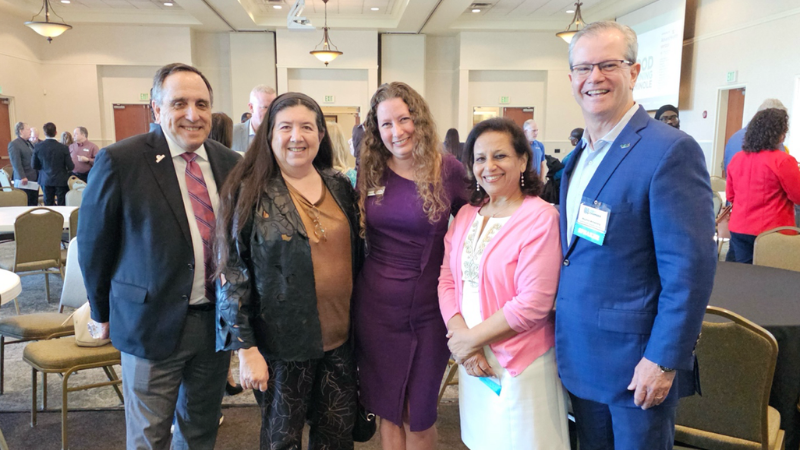
Moderated by Seminole County Commissioner Andria Herr, panelists included Waymon Armstrong, founder and chief executive officer of Engineering & Computer Simulations (ECS); Dolly Oberoi, chief executive officer of C2 Technologies, Inc.; George Cheros, president and chief executive officer of the National Center for Simulation (NCS); and Carolina Cruz-Neira, executive director of the Pegasus Research Institute (PRI) and executive director of UCF’s Institute for Simulation and Training (IST).
The discussion highlighted Orlando’s role as a hub for MS&T, tracing the region’s growth from early military and academic collaborations to its current status as a center for innovation. Cruz-Neira described how decades of partnerships between academia and private industry have helped shape the ecosystem, providing research, education and a steady pipeline of talent.
“Our students are not just learning in the classroom — they are actively contributing to research projects and helping develop solutions that address real-world challenges,” Cruz-Neira said. “This hands-on involvement allows them to gain experience while simultaneously advancing the work of industry and government partners, creating a direct link between education and innovation in Central Florida.”
Cruz-Neira also emphasized UCF’s ability to adapt to evolving workforce needs through certificate programs and hands-on learning opportunities that help students build in-demand skills.
“We can’t always wait for a four-year degree to meet workforce demands,” Cruz-Neira said. “These programs allow us to quickly prepare students with the skills industry and government partners need right now.”
Panelists then turned to the role of private industry in applying MS&T technologies. Armstrong highlighted ECS’s work in both defense and civilian sectors, explaining how the company develops and implements complex simulation systems across multiple industries and operational environments, supporting everything from technical training to organizational readiness.
“From surgical training simulators to emergency response systems, the innovations developed here are designed to make a tangible difference,” Armstrong said. “Our goal is to bridge research and practice so that technology directly benefits people and communities.”
He also emphasized Central Florida’s unique position as a hub for MS&T, where partnerships among the military, academia and private industry foster innovation and practical applications.
“The technologies developed in this area aren’t just theoretical — they are implemented locally and globally, benefiting both the community and the broader MS&T field,” Armstrong said. “They influence how people are trained, how organizations operate and how industries innovate across multiple sectors.”
Cheros highlighted the economic impact of the MS&T industry, noting that the collaboration between government, academia and private industry generates billions in economic activity and supports tens of thousands of local jobs.
“This industry doesn’t just create technology — it creates opportunities,” Cheros said. “The partnerships here in Central Florida sustain high-wage jobs, drive innovation and provide a pipeline of talent that keeps our community strong.”
He also described NCS’s efforts to engage the next generation, including K–12 STEM programs such as Starbase and college-level certificate courses that equip students with the skills needed for careers in simulation and training.
“We start introducing students to simulation and training as early as fifth grade,” Cheros said. “By giving them hands-on experiences and real-world exposure, we’re helping build the workforce of tomorrow while inspiring the next generation of innovators.”
People who read this article also found these articles interesting :


INDUSTRY NEWS


