


TOPICS & CATEGORIES
By Shane Klestinski, Associate Editor
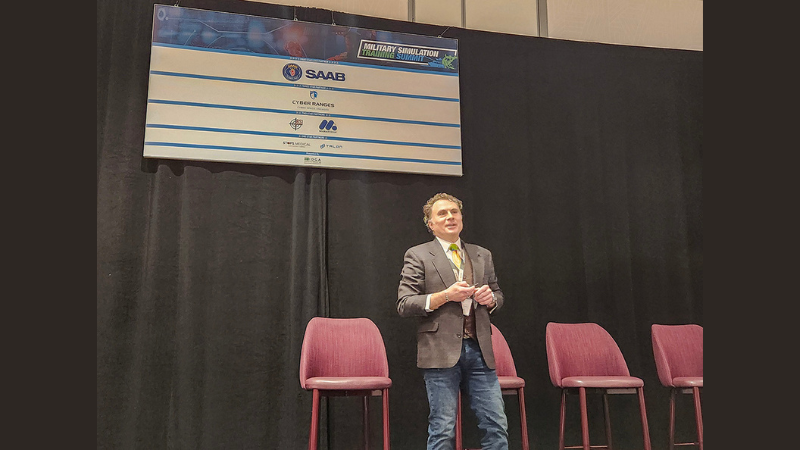
Darren Buck, deputy commander and executive director of the U.S. Space Force’s Space Delta 1, delivered his presentation on “How the U.S. Space Force Uses Simulation Training” at the Institute for Defense and Government Advancement’s (IGDA) Military Simulation Training Summit in Orlando, Florida, Feb. 26.
IGDA’s two-day summit gathered over 300 senior training commanders, procurement officers and acquisitions leaders from across the military and provided a forum for networking and collaboration. This conference focused on training warfighters with simulation and synthetic training, and it explored how militaries (American and allied) are approaching interoperability with new technology and moving toward competency training.
Buck started his talk by describing the Space Force’s basic structure in its similarities and differences from the Air Force, from which it originated in December 2019. He explained that a “delta,” the O-6 echelon, “is essentially a mashup of the old Air Force echelons of group, wing and numbered Air Force [units] mashed together.” When the Space Force stood up and reorganized itself, according to Buck, it removed two echelons command. His delta, Space Delta 1, operates within the Space Training and Readiness Command to oversee training in five states. Buck also outlined the Space Force’s present trainee output and training programs as it continues growing through its early stages as the newest and smallest military service.
“[We’re currently] riding the coattails of basic military training for the Air Force, which… as a service, graduates about 600 to 700 new airmen every Thursday,” Buck said. “We graduate about 120 new Guardians every eight weeks.”
Buck said that initial skills training for new enlisted members involves space operations training, cyber training or ISR (intelligence, surveillance, reconnaissance) training. He explained that while much of this training relies on the Air Force’s established training programs for both Space Force enlisted and officer personnel, its officers now have a new program as of last September.
“This past year, we consolidated all of that [training] into a single, 12-month course, so all new officers coming into the Space Force will all go through this singular course, become Guardians, and then go off to operational jobs,” Buck said. “From there, they may go off in their second assignment to continue with an operational assignment in space operations as a crew commander or a flight commander, a cyber professional, an ISR assignment, or a force modernization [position], which is our acquisition and engineering course.”
Buck later focused his talk on the Space Force’s simulation training, most of which, he described as “homegrown or garage hobby projects” that instructors and training coordinators saw value in using for Guardians’ benefit. Certain systems have been around for some time, like the System Tool Kit (formerly known as the Satellite Toolkit), the engineering-based Advanced Framework for Simulation, Integration and Modeling (AFSIM), and others that have seen previous use in air and space operations centers. He also explained that preparing warfighters for space operations is unlike training in previous warfighting domains, and it presents different challenges.
“Teaching enlisted or officers about how to operate in space is counterintuitive to surface warfare,” Buck said. “Terrestrial warfare is a certain branch of physics, atmospheric warfare is a certain branch of physics, and space warfare is a whole different end of this physics spectrum. [Instructors] don’t like the fact that they have to spend almost as much time teaching students how to code in AFSIM as they do teaching the concepts. Their comment is: ‘It’d be great to have some tools that are a little more user friendly just to teach the concepts, because that’s the most important thing.’”
Given those circumstances, Buck said he was looking forward to learning from industry about new capabilities and technologies that are available to better move forward, innovate and apply new tool sets toward improving training efforts.
He went on to mention some progress the Space Force has already made in establishing new training tools. For example, Space Wargaming Analysis for Readiness and Mission (SWARM) planning is a newly developed and highly integrative interface that Space Force trainers believe shows promise.
“We’re very optimistic about how SWARM can help us enhance the live/virtual/constructive setup that the 392nd Combat Training Squadron currently utilizes to do large force exercises,” Buck said. “So, we’re probably going to have instances of SWARM installed at actual operational units so they can be on the floor where they normally do their operations and participate in space wargaming and exercises.”
Later in his talk, Buck emphasized the practical importance of forces whose readiness level would make them combat ready in the present. Before taking questions, he ended his prepared remarks by stressing that “Operational Test and Training Infrastructure should be the Space Force’s number one modernization effort.”
People who read this article also found these articles interesting :




INDUSTRY NEWS


