


TOPICS & CATEGORIES
By Cassidy Mills, Senior Staff Writer
October 2, 2026
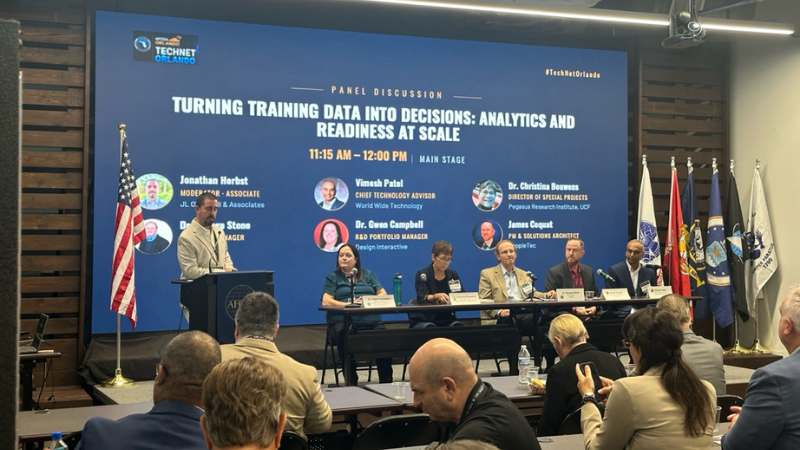
Experts from the military, industry and academia discussed how training data can support readiness decisions during the “Turning Training Data into Decisions: Analytics and Readiness at Scale” panel at TechNet Orlando 2026 on Sept. 17.
Hosted by the Armed Forces Communications & Electronics Association International (AFCEA) Orlando Chapter, TechNet Orlando brought together military, government, industry and academic leaders to discuss emerging technologies, challenges and solutions supporting the defense and national security community.
Moderated by Jonathan Herbst, associate at JL O’Connell & Associates, the panel examined how organizations can collect, preserve, analyze and share training data while determining which information provides meaningful measures of readiness.
Panelists included Vimesh Patel, chief technology advisor for Federal at World Wide Technology; George Stone, Ph.D., program manager at QinetiQ US; Jay Coquat, program manager and solutions architect at PeopleTec, Inc.; Christina Bouwens, Ph.D., director of special projects for the UCF Pegasus Research Institute; and Gwen Campbell, Ph.D., R&D portfolio manager for Design Interactive.
Herbst opened the discussion by pointing to the volume of information now generated through live training ranges, virtual and constructive environments, learning platforms and wearable sensors.
“We have never collected more training data from live ranges, from virtual and constructive simulations, from learning platforms, from the wearable on the warfighter’s wrist,” Herbst said. “Now, we have never been further from turning it into a decision.”
Stone focused on data generated during live training and how information can be lost between collection and analysis. He said the value of training data depends on maintaining it throughout the process so it can ultimately inform decisions.
“The signal dies at the source. Most of what we instrument never survives the AAR,” Stone said. “The instrumentation is actually very helpful only when the data itself is well recorded.”
He also addressed interoperability among live, virtual and constructive training environments, adding that data from different systems and organizations requires sufficient context and metadata to support analysis.
Bouwens focused on the difference between measuring activity and measuring performance. Training organizations can collect information such as hours completed, tasks performed and scores, but she said those measures do not necessarily provide a complete picture of readiness.
“Readiness really requires intention. You have to plan for it, you have to prep for it, and you need proper instrumentation,” Bouwens said. “You don’t just measure everything and figure it out later; you have to think about what you’re going to measure and what you’re really going to get out of performance.”
She added that effective measurement needs to be planned before training begins, including identifying performance questions and determining what data and instrumentation are required.
Campbell discussed the use of human-performance sensors to collect information about workload, stress, attention and physiology. She said more precise measurements do not necessarily translate into better decisions.
“Human performance data collected from sensors does not create decision-grade insights; it creates observations,” Campbell said. “Those observations remain mostly noise until they’re contextualized, reused with other evidence, validated and shown to improve real decisions.”
Campbell emphasized organizations should first define the decision they are trying to support and then determine what measurements are needed.
Patel addressed the challenge of working with information from different systems and organizations. Drawing on his experience in federal data strategy, he said establishing common standards can be difficult when organizations already have systems and processes in place.
“I think chasing standards, trying to create a standards activity in this world, may not make sense,” Patel said. “We can apply technologies to the data that we have today and try to move faster than creating a universal standards board.”
Patel said emerging technologies, including artificial intelligence, could provide additional ways to work with information without requiring every source to use the same structure.
Coquat focused on connecting information from different systems and making data useful to the people who collect and use it. Drawing on his background in Army aviation, he described the separation that can exist between logistics records and training or proficiency information.
“The model ranks and the human supplies, and every number drills to an event,” Coquat said. “The chain of custody was all the way there to be verified, so a human was always in the loop.”
He also discussed designing systems around the decisions users need to make rather than their organizational level, while maintaining access to detailed source data.
“Build for the decision, not the echelon,” Coquat said. “You cannot build for the operational or strategic levels without the fine-grain data, and that’s how they end up being useful at the tactical level.”
Coquat concluded that analytics should support human decision-makers while allowing results to be traced back to the underlying data.
The panelists also discussed standards and interoperability as they considered how information moves between military organizations and industry partners. Stone, Patel and Coquat addressed different aspects of the challenge, including preserving data, working across existing systems and maintaining access to underlying information.
“Interoperability starts with preserving the context around the data,” Stone said. “If we can’t move that information between live, virtual and constructive environments with the right metadata, we lose the ability to understand what the data is telling us.”
People who read this article also found these articles interesting :


INDUSTRY NEWS


