


TOPICS & CATEGORIES
By Cassidy Mills, Senior Staff Writer
September 16, 2026
The University of Central Florida (UCF) and SpaceWERX formally partnered Sept. 9 to establish the SpaceWERX East Coast Innovation Gateway, creating a new connection between the U.S. Space Force’s innovation enterprise and Central Florida’s researchers and technology ecosystem.
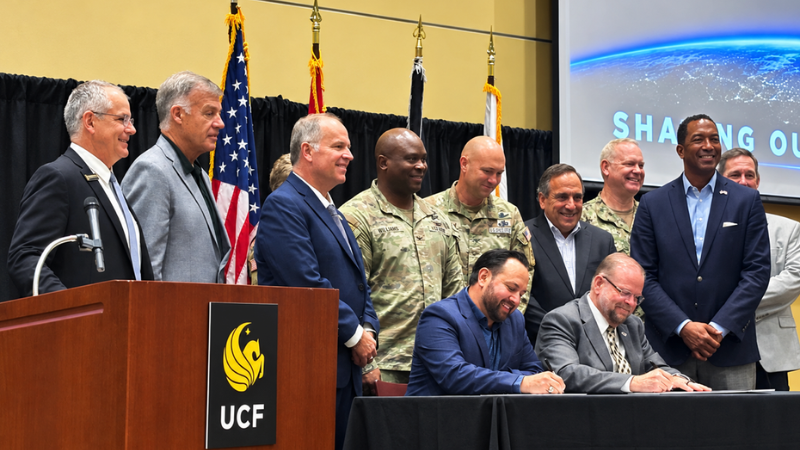
The partnership was celebrated during a signing ceremony at UCF’s Morgridge International Reading Center, where UCF President Alexander N. Cartwright, Ph.D., and Arthur Grijalva, director of SpaceWERX, signed the partnership agreement in the presence of Team Orlando leaders.
SpaceWERX serves as the innovation arm of the Department of the Air Force, working with startups, small businesses, nontraditional companies, academia, investors and defense stakeholders to accelerate the development and transition of new technologies.
The East Coast Innovation Gateway expands SpaceWERX’s national innovation network into Central Florida and strengthens connections among government, academia, industry and entrepreneurs.
Cartwright and Grijalva were introduced during the ceremony by Eric “Tubby” Shwedo, UCF’s associate vice president for Federal Relations in the Office of Government & Community Relations. He opened the ceremony by emphasizing the significance of the partnership.
“Today’s signing marks more than the establishment of SpaceWERX’s presence in Central Florida,” Shwedo said. “It represents a shared commitment to accelerating innovation, strengthening national security, and creating new opportunities for collaboration among government, academia, industry and entrepreneurs.”
He pointed to UCF’s origins as an institution created to support America’s emerging space mission and said that mission continues through the university’s research, workforce development and partnerships.
“The establishment of SpaceWERX’s East Coast Innovation Gateway further strengthens an ecosystem nationally recognized for excellence in space, defense, modeling and simulation, advanced technologies and workforce development,” Shwedo said.
The gateway is designed to create new pathways connecting military operators, researchers, entrepreneurs, industry partners and students to help address some of the nation’s most pressing challenges.
Cartwright noted that the partnership represents a natural extension of UCF’s founding mission.
“Our mission was to provide the talent and technology that the nation needed to support an ambitious new mission in space,” Cartwright said. “The missions have changed drastically, dramatically, over the last 60 years. But UCF’s role and commitment to that has not changed.”
Cartwright said UCF remains focused on solving problems, developing the workforce and providing students with opportunities to enter industries that are shaping the future.
He also emphasized the growing challenge of preparing workers for rapidly advancing technologies and connecting research, technology and talent in ways that benefit the nation.
“There are many hard problems that all of us need to solve as we move forward,” Cartwright said. “And even developing a new workforce is one of those brand new challenges.”
He said the partnership with SpaceWERX can help bring together the researchers who understand complex missions, entrepreneurs who recognize opportunities, industry partners capable of scaling successful technologies and government organizations that understand real-world operational needs.
“We don’t have a shortage of good ideas. This is the most innovative country in the world,” Cartwright said. “Our challenge is how we take those good ideas and turn them into practical applications.”
He said that process requires institutions such as UCF to serve as a bridge among research, entrepreneurship, industry and government.
“When you can bring academia, industry and government together, good ideas will move faster,” Cartwright said. “Research will become capability, talent will become our workforce, and the partnerships will drive the solutions that we need.”
Grijalva said UCF’s access to talent and research makes the university an important partner for SpaceWERX.
“The way I see it, America’s greatest strength is innovation and ingenuity,” Grijalva said.
Grijalva said SpaceWERX is focused on helping the nation move faster in developing and fielding capabilities. He described the organization as part of a broader effort to transform how the Department of the Air Force acquires technology, including through the greater use of commercial innovation and accelerating transition of promising technologies into the hands of military operators.
“We work with small businesses, startups, non-traditionals, academia and private capital,” Grijalva said. “We take the best ideas, use the flywheel of commercial innovation, and ultimately transition those into the hands of the warfighter.”
That process can begin with an idea developed by a small team or startup and eventually result in a technology being demonstrated or deployed for a national security mission.
Grijalva said SpaceWERX invests hundreds of millions of dollars annually in innovation and relies on partnerships to identify technologies that can make a difference.
He also highlighted the value of UCF’s students, faculty and laboratories and the university’s ability to connect research with commercialization.
“There’s the student, there’s the faculty, there’s the laboratories, there’s also that research,” Grijalva said, describing the potential for SpaceWERX and UCF to work together with other academic institutions to move research toward commercialization.
The partnership also builds on Central Florida’s position within the nation’s space ecosystem.
The region links UCF’s research and workforce capabilities with the Space Coast, Kennedy Space Center, Space Florida, aerospace and defense companies, military organizations, modeling and simulation institutions, entrepreneurs and economic development organizations.
The event included representatives from Space Florida, the Economic Development Commission of Florida’s Space Coast, the Florida High Tech Corridor, the Space Force Association, the U.S. Army’s Future Training Directorate, the U.S. Army Simulation and Training Technology Center, the Naval Air Warfare Center Training Systems Division and the Program Manager for Training Systems, among other organizations.
The partnership comes as the space domain becomes increasingly important to national security and as government agencies look to commercial companies and universities for technologies that can be developed and deployed more quickly.
People who read this article also found these articles interesting :


INDUSTRY NEWS


