


TOPICS & CATEGORIES
By Mason Gray, Staff Writer
October 28, 2026
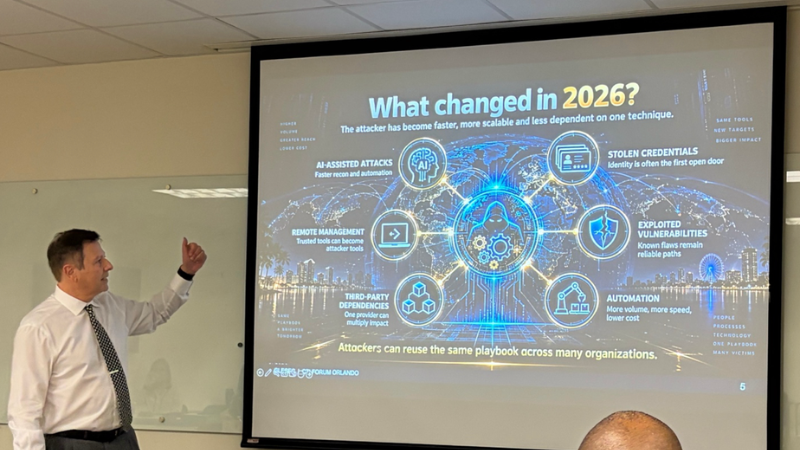
The National Center for Simulation (NCS) hosted a Cyber Threat Intelligence Forum on Oct. 13 at the University of Central Florida (UCF), bringing together industry experts to examine growing cyber threats and strategies for strengthening organizational security.
Sergio Heker, founder and CEO of cybersecurity firm GLESEC, discussed cybersecurity challenges, the importance of identifying potential risks and ways to improve threat detection and response.
Heker opened the forum by comparing the speed of cyberattacks with the time organizations need to detect and address them.
“The attackers are moving faster because of a number of things, AI and automation,” Heker said. “And unfortunately, we continue to be very slow to react to things.”
According to figures presented by GLESEC, 1,094 U.S. ransomware victim posts were recorded in the first half of 2026, accounting for approximately 49 percent of observed global activity — a 51 percent increase from the same period in 2025.
Heker said attackers can breach organizations in six days, while it takes organizations an average of 241 days to discover a compromise. He attributed delayed responses to factors such poor communication between departments, outdated systems and manual processes.
He identified eight common cybersecurity challenges: exposed infrastructure, legacy technology, exposed access and VPNs, limited asset visibility, slow remediation, uneven detection, reactive response and the lack of verifiable resolution.
Heker used examples of aging equipment and internet-connected devices to explain how security vulnerabilities can go unnoticed.
“My favorite is limited asset visibility, because we cannot protect what we don’t know,” Heker said. “Some people don’t even know how we define critical assets, but even if they do, they don’t necessarily know which are their critical assets in the organization.”
Heker outlined a six-step process for turning threat intelligence into action: collecting information, adding context, prioritizing threats, validating risks, taking action and verifying resolution.
He said organizations often collect large amounts of security data but struggle to distinguish meaningful threats from background noise.
“As long as these signals are not analyzed, they’re just noise,” Heker said. “But when we take this and we apply this context and we apply relevance, then we start to get something out of that.”
Heker introduced GLESEC’s SKYWATCH platform, which helps organizations monitor threats, identify security risks and manage responses in one system.
Using a hypothetical company website as an example, he demonstrated how the platform could identify possible threats, determine which systems might be affected and track remediation.
Attendees asked about the role of artificial intelligence in cybersecurity and whether automated systems could respond to threats quickly enough.
Heker said AI can help security teams detect unusual activity and respond more quickly, but human oversight remains necessary to review information and make decisions.
“At this point, we still have a job, and our brains are still necessary,” Heker said. “But we are complementing these with all the new capabilities that exist.”
The discussion also addressed communication between departments, particularly when different teams are responsible for protecting separate parts of an organization.
Heker described cases in which security issues passed between departments without resolution, leaving systems at risk.
“People don’t communicate effectively enough across the organization,” Heker said.
He closed by reflecting on his firm’s relationship with NCS and encouraging continued collaboration on cybersecurity challenges.
“The spirit for the presentation was to have a discussion and to learn from what you guys are saying, but also to stimulate collaboration in what we are doing,” Heker said. “If there is anything that we can share, we can be part of, we’re interested and so happy to collaborate.”
People who read this article also found these articles interesting :



INDUSTRY NEWS


